

How Long Does An Ivc Filter Stay In Place?
This data will help you get gear up for your inferior vena cava (IVC) filter placement past the Interventional Radiology Department at Memorial Sloan Kettering (MSK).
Dorsum to tiptopAbout Your IVC Filter
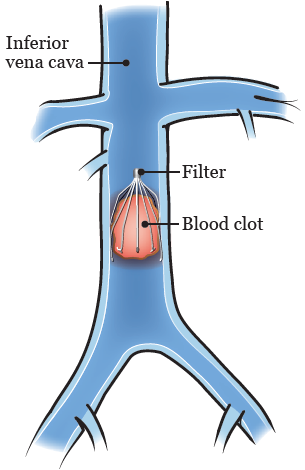
Figure 1. IVC filter
The inferior vena cava is the largest vein in your torso. Information technology carries blood from your lower body to your heart and lungs.
A blood jell in a vein below your heart blocks your normal blood flow and may cause swelling, redness, and pain in the expanse. Blood clots are treated with blood thinners but some people may not exist able to receive this treatment. In those cases, an IVC filter may be placed
An IVC filter is a small device that is placed in your inferior vena cava to forestall blood clots from moving through your blood into your lungs (come across Figure i).
Your IVC filter will be placed past your interventional radiologist. An interventional radiologist is a doctor who specializes in prototype-guided procedures. They volition place the IVC filter in your inferior vena cava past going through a vein in your cervix or groin. Your doctor will position the IVC filter in the vein using a fluoroscopy (real-time ten-rays).
The procedure volition take about 30 minutes, but you should wait to exist in the procedure room for about an hour. You lot'll have a follow-up appointment 4 to vi weeks after placement to see when your IVC filter tin be removed.
Dorsum to topBefore Your Process
Inquire about your medications
You may need to finish taking some of your medications earlier your procedure. Talk with your healthcare provider about which medications are condom for you to stop taking. Nosotros've included some common examples beneath.
Blood thinners
If you take a claret thinner (medication that affects the mode your blood clots), ask the healthcare provider performing your process what to do. Their contact data is listed at the end of this resource. Whether they recommend you stop taking the medication depends on the type of procedure you're having and the reason you lot're taking blood thinners.
Examples of blood thinners include:
|
|
Practise not stop taking your blood thinner medication without talking with a member of your intendance team.
Read Common Medications Containing Aspirin, Other Nonsteroidal Anti-inflammatory Drugs (NSAIDs), or Vitamin Due east. It has of import information near medications you'll need to avoid before your procedure and what medications you can take instead.
Medications for diabetes
If you accept insulin or other medications for diabetes, ask the healthcare provider who prescribes your medication what you should do the morn of your procedure. You may need to change the dose before your process. Your healthcare providers will be checking your blood carbohydrate level during your procedure.
Diuretics (h2o pills)
If you have any diuretics (medications that make you urinate more often), inquire the healthcare provider performing your procedure what to do. You may need to terminate taking them the day of your process. Diuretics are sometimes called water pills. Some examples are furosemide (Lasix®) and hydrochlorothiazide.
Contrast dye
Contrast is a special dye that makes it easier for your physician to meet differences in your internal organs. This process is usually done with contrast. If yous've had a reaction to contrast in the past, tell your healthcare provider.
If you're breastfeeding, you may choose to proceed after your procedure with contrast. If you have questions or would like to discuss dissimilarity and breastfeeding, talk with your radiologist on the day of your procedure.
Remove devices from your peel
If you wear any of the following devices on your pare, the manufacturer recommends you remove it before your browse or procedure:
- Continuous glucose monitor (CGM)
- Insulin pump
Talk with your healthcare provider nigh scheduling your appointment closer to the date you lot need to change your device. Make sure you take an extra device with you to put on after your browse or process.
If you're not sure how to manage your glucose while your device is off, talk with the healthcare provider who manages your diabetes intendance before your appointment.
Arrange for someone to take yous home
You must have a responsible care partner take y'all abode after your procedure. A responsible intendance partner is someone who tin help you get home safely. They should be able to contact your intendance team if they have whatever concerns. Brand certain to plan this before the 24-hour interval of your procedure.
If you don't have a responsible care partner to take you lot domicile, call one of the agencies below. They'll send someone to go home with you. In that location'due south often a accuse for this service, and yous'll need to provide transportation. It's OK to use a taxi or car service, but you all the same need a responsible care partner with you.
Tell the states if yous're ill
If you get sick (such as take a fever, common cold, sore throat, or the flu) before your process, call your doctor in Interventional Radiology. You can attain them Mon through Fri from to After , during the weekend, and on holidays, call 212-639-2000 and inquire for the Interventional Radiology fellow on call.
Note the time of your engagement
A staff member from Interventional Radiology will phone call you lot 2 business days (Mon through Friday) before your procedure. If your procedure is scheduled on a Mon, they'll call y'all on the Thursday before. If you don't get a call past apex on the business day before your procedure, call 646-677-7001.
The staff member will tell you lot what time to go far at the hospital for your procedure. They'll too remind y'all where to go.
Utilise this surface area to write down the appointment, fourth dimension, and location of your procedure:
If you need to abolish your procedure for any reason, phone call the healthcare provider who scheduled it for you.
Back to topThe Day Before Your Procedure
Instructions for eating earlier your procedure
Do not eat anything later midnight the night before your process. This includes hard candy and mucilage.
The Day of Your Procedure
Instructions for drinking before your procedure
Yous tin can drink a total of 12 ounces of water between midnight and ii hours before your scheduled arrival time. Practise not drink anything else.
Do not drink anything starting two hours earlier your scheduled arrival time. This includes h2o.
Things to remember
- Take only the medications your doctor told you lot to take the forenoon of your procedure. Take them with a few sips of water.
- Don't apply cream or petroleum jelly (Vaseline®). You tin use deodorant and moisturizers. Don't wearable center brand-up.
- Remove any jewelry, including body piercings.
- Exit all valuables, such as credit cards and jewelry, at home.
- If yous wear contact lenses, wear your spectacles instead, if possible. If you don't have glasses, delight bring a case for your contacts.
- Wearable loose, comfy clothing.
What to bring with you
- A list of the medications you lot take at domicile.
- Medications for breathing problems (such as inhalers), and medications for breast pain, if you lot take any.
- A case for your glasses or contacts.
- Your Wellness Care Proxy course, if you have completed one.
- If you use a CPAP or BiPAP machine to sleep at dark, please bring your auto with y'all, if possible. If y'all tin can't bring your car with you, nosotros volition give you 1 to employ while you're in the hospital..
- A small pillow or towel to make you feel more than comfy on your manner home from the hospital.
What to await
Once you get in, doctors, nurses, and other staff members will ask you to state and spell your name and engagement of nativity many times. This is for your safety. People with the same or similar names may be having procedures on the same twenty-four hours.
After changing into a hospital gown, you lot'll meet your nurse. They will place an intravenous (Four) catheter into a vein, normally in your hand or arm. At beginning, yous'll receive fluids through the IV, only it will be used later to give you medication to make you sleepy and more than relaxed during your procedure.
Your doctor will explain the procedure, and answer any questions yous have. They will too enquire yous to sign a consent course (a form that says y'all agree to the procedure and understand the risks).
You'll be brought into the procedure room and helped onto the table. You'll lie flat on your back. The skin around your insertion site (your neck or groin) will be cleaned and covered with a pall. You'll get an injection (shot) to numb the site. Your interventional radiologist will place the IVC filter through a modest incision (surgical cutting) made in your insertion site.
When the procedure is finished, the site volition be cleaned and covered with a cast.
Dorsum to topAfter Your Procedure
In the recovery room
You'll be taken to the recovery room or hospital bed. Your nurse will explain your discharge instructions to you and your caregiver before you become home. They'll as well give yous a wallet card with information about your IVC filter to keep with y'all.
Wearing a seatbelt may put pressure level on your incisions. You may desire to place small pillow or folded towel betwixt the strap and your torso when you go home.
At dwelling house
Caring for yourself
- Leave the bandage on the insertion site for 24 hours. Subsequently 24 hours, y'all can accept it off.
- Your incision may experience sore. This should go ameliorate within a day or 2. Y'all can take over-the-counter pain medication, such equally acetaminophen (Tylenol®) or ibuprofen (Advil®), if yous demand it.
- You can shower 24 hours afterward your process.
Activities
- For the first few days, yous should avert certain activities, such as exercises that involve stretching.
- You tin can even so have a magnetic resonance imaging (MRI) while you take an IVC filter, but it'southward important to tell the healthcare provider at the radiology facility each time to be safe. Show them the wallet menu your nurse gave to you.
- Your IVC filter won't set off metal detectors.
Follow-Up Appointment
- Y'all'll have a follow-upwardly appointment with your interventional radiologist about 4 to vi weeks after your process. During this appointment, your medico will determine whether your IVC filter volition be removed.
- After your procedure, telephone call your dr. in Interventional Radiology to schedule an appointment.
When to Call Your Healthcare Provider
Call your healthcare provider if you accept any of the following:
- A fever of 100.iv° F (38° C) or higher
- Pain around your insertion site that doesn't go away afterwards taking medication
- Drainage effectually the incision site
- Redness and swelling effectually your insertion site

How Long Does An Ivc Filter Stay In Place?,
Source: https://www.mskcc.org/cancer-care/patient-education/ivc-filter-placement
Posted by: beasleydody1988.blogspot.com
0 Response to "How Long Does An Ivc Filter Stay In Place?"
Post a Comment